A factory shoot takes a day or two on site. Almost everything that decides whether the results are good is settled in the weeks before the crew arrives, and most of it sits with your team rather than ours.
This is the preparation list we send manufacturers commissioning industrial photography or industrial video for the first time. None of it is difficult or expensive. All of it is considerably cheaper to do beforehand than to fix afterwards, and some of it cannot be fixed afterwards at all.
Start With the Walkthrough
For anything larger than a single hall, we walk the site before shoot day. That visit sets the shot list, identifies which lines will be running, establishes where the pictures actually are, and surfaces the access and safety requirements that shape the schedule. Our guide to how a factory shoot works covers what we are looking for while we walk.
Send the person who knows the plant, not only the person who commissioned the project. The maintenance lead and the production supervisor will tell us in ten minutes what a brief takes three emails to approximate.
Machinery: Paint and Touch-Ups Come First
Walk your machines the way a camera will see them, which is closer and more literally than you do every day. Chipped paint, rust bloom, faded labels, oil streaks and scuffed guarding all read far louder in a photograph than they do in person. A fresh coat of paint where it is needed, and touch-ups everywhere else, is the highest-return preparation on this list.
For film it is not merely worth doing, it is close to mandatory. A still photograph can be retouched. A moving shot effectively cannot: retouching video frame by frame as the camera travels is impractical on any normal budget, so whatever the lens passes over is what appears in the final cut. If a machine is going to be filmed, its condition on the day is its condition forever.
Housekeeping, Including the Surfaces Nobody Looks At
Clear cobwebs and remove dust from flat surfaces. This sounds trivial and it is the item that most often costs a client a frame.
The reason is the angle. To show the full length of a line, or to give a hall a sense of scale, we frequently shoot from above eye level, from a platform, a mezzanine or a ladder. That viewpoint reveals the tops of cabinets, machine guards, ducting, conduit runs and beams, surfaces that in a great many plants have not been cleaned in years because nobody has ever stood high enough to see them. They photograph as a grey film of dust across an otherwise well-run factory.
Floor markings deserve the same attention. Safety lines, walkway paint, bay demarcations and signage appear in nearly every wide frame, and faded lines or peeling notices read to a viewer as a plant that is not maintained. That is precisely the opposite of what the images exist to say. Repainting worn floor markings and replacing tired notices before the shoot is quick, cheap, and visible in every establishing shot for years.
Your People in Frame
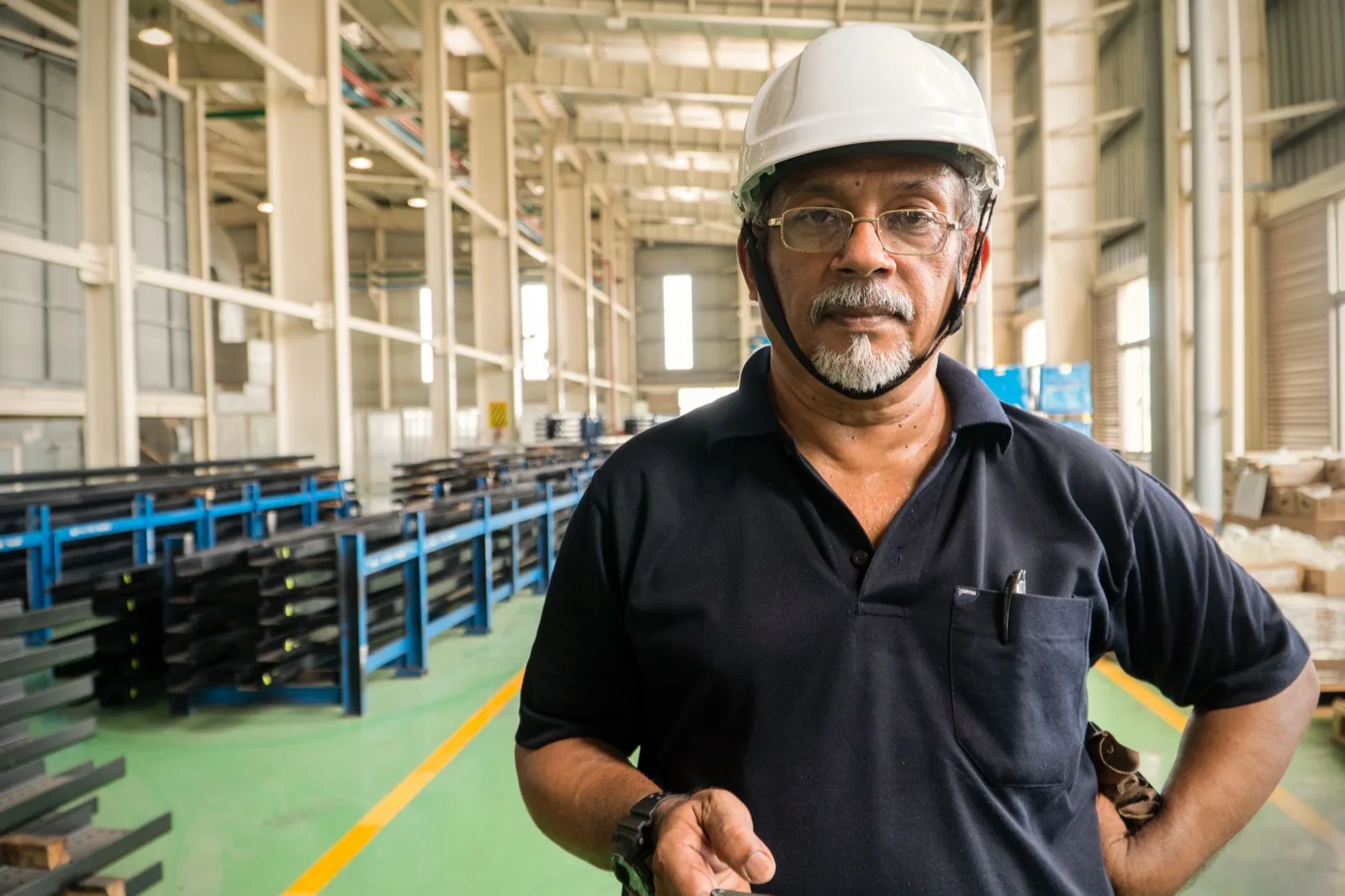
Anyone who will appear in a photograph should be in uniform, with the appropriate PPE for their area and, at minimum, proper shoes. A single person in sandals undoes an otherwise excellent frame, and it cannot be corrected later without removing them from the picture entirely.
Tell your team in advance which areas are being photographed and on which day. People behave more naturally when they have known for a week than when a camera appears at their station unannounced. It is also the moment to find out who would rather not be photographed at all, which is far easier to accommodate in planning than on the day.
Safety Stays With Your Team
We arrive inducted, in PPE, and we follow your site’s rules without argument. What we cannot do is decide what is safe in your plant.
Safety precautions during the shoot should be overseen by a supervisor from your side with the competence to make those calls: what may be approached and from what distance, what must stay guarded, what can be paused and what absolutely cannot, which areas need an escort. We are photographers and filmmakers, not authorities on your processes or your hazards. Having the right person accompanying us is both the safe arrangement and the fast one, because decisions get made on the floor instead of being escalated.
Access, Scheduling and Who We Need on the Day
Shoot days are planned around your operations rather than the reverse. To do that we need shift timings, a realistic picture of which lines will be running, and any windows when a particular area is quiet enough to light properly.
On the day, we need an escort who knows the plant and someone empowered to make small decisions quickly. A great many good frames are lost waiting for permission to move a pallet.
Preparation Is Cheaper Than a Reshoot
Everything above exists to avoid one outcome. A reshoot means travel again, induction again, disruption to production again, and a delay to whatever the images were commissioned for, whether that is a trade show, an investor pack or a website launch. It is expensive, and for the client team it is tiresome in a way that the invoice does not capture.
A day of cleaning, a few litres of paint and a briefing to the shop floor is a trivial cost against that, and it is the difference between a factory that photographs as a serious operation and one that photographs as a dim building with machines in it.
If you are planning a shoot, it is usually worth capturing stills and film on the same visit, since one visit shares the planning, the access and much of the cost. Message +91 99624 28747 on WhatsApp with a line about your facility and what the images need to do, and we will send back a scope, a shot list to work from, and this checklist adapted to your site.